
 By
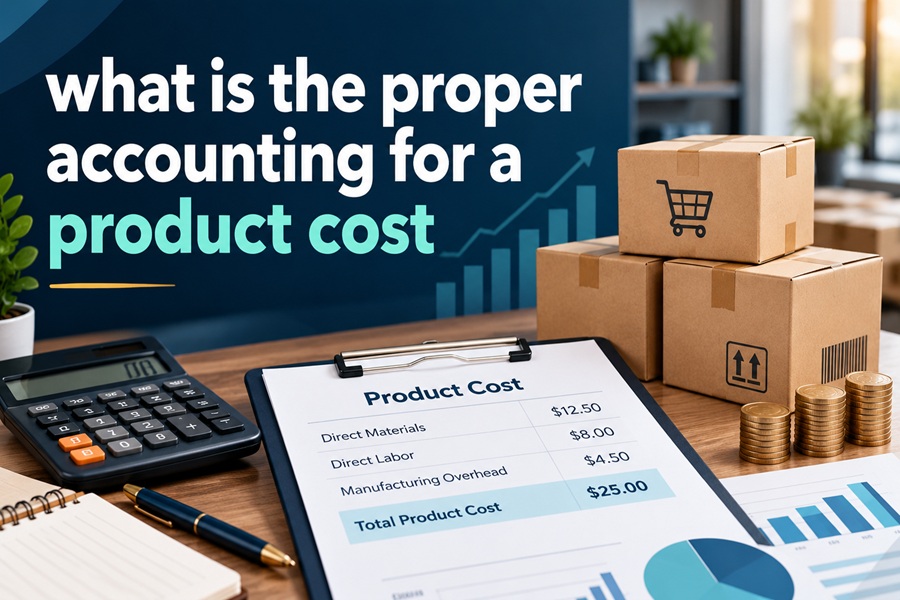
A product does not cost what you paid for it. It costs what it took to get it ready to sell.
That sentence settles most arguments about product cost. The price on a supplier’s invoice is only the first chapter. Freight, labor, the electricity that ran the machine and the rent on the space where it all happened all belong to the story, and proper accounting means deciding which chapters get written into the product’s cost and which belong somewhere else.
To see how this plays out, follow one ceramic mug from a bag of clay to a customer’s hands.
The golden rule of inventory cost
Both major accounting frameworks agree on the principle. Inventory is recorded at the cost of bringing it to its present location and condition. If a cost helps make the item or deliver it to your door in sellable form, it goes into inventory. If it relates to selling the item or running the business in general, it is an expense of the period.
Costs that belong in the product:
- The purchase price, less trade discounts and rebates
- Import duties and non refundable taxes
- Freight and handling to get materials to your workshop
- Direct labor of the people who make it
- Manufacturing overhead, such as factory rent, equipment depreciation and utilities for the production area
Costs that do not belong in the product:
- Marketing and advertising
- Sales commissions and delivery to the customer
- General administration, such as bookkeeping fees and office salaries
- Abnormal waste, like a kiln failure that cracks a whole batch
- Storage costs after production, unless storage is a necessary step before the next stage
Our mug, costed
A potter named Dev makes mugs in a small studio. Here is what one mug costs.
| Cost element | Amount per mug |
|---|---|
| Clay | 4.00 |
| Glaze | 0.80 |
| Freight in on clay and glaze | 0.30 |
| Direct labor (about 35 minutes of throwing and finishing) | 3.50 |
| Applied overhead (kiln power, studio rent, tool wear) | 1.40 |
| Total product cost | 10.00 |
Dev sells the mug for 24.00. The packaging, the website fee and the courier charge to the buyer are selling costs, so they hit the income statement as ordinary expenses and never touch the 10.00.
The three layers of manufacturing cost
Accountants group production costs into three buckets.
- Direct materials are the ingredients you can trace to a single unit, like clay and glaze.
- Direct labor is the pay of workers who physically make the product.
- Manufacturing overhead is everything else needed for production that cannot be traced to one unit, such as equipment depreciation, supervision and factory utilities.
The first two are easy to trace. The third needs a method.
How overhead gets onto the product
Overhead is spread using a predetermined rate. Dev estimates the year’s overhead at 12,000 and expects 3,000 hours of production work. That gives a rate of 4.00 per labor hour. A mug that takes 0.35 hours picks up 1.40 of overhead.
Why estimate in advance instead of waiting for the real bills? Because Dev needs a cost on the day the mug is finished, not in December. At year end, actual overhead is compared with applied overhead, and the difference is cleaned up, usually by adjusting cost of goods sold if the amount is small.
The journal entries, in order
Costs move through accounts as the product moves through the studio.
- Buy clay and glaze: debit Raw Materials, credit Accounts Payable or Cash.
- Send materials to the workbench: debit Work in Process, credit Raw Materials.
- Pay for labor: debit Work in Process, credit Wages Payable.
- Apply overhead: debit Work in Process, credit Overhead Applied.
- Finish the batch: debit Finished Goods, credit Work in Process.
- Sell a mug: debit Cash or Receivables, credit Sales Revenue. Then debit Cost of Goods Sold, credit Finished Goods for 10.00.
The cost sits on the balance sheet as an asset until the sale happens. Only then does it jump to the income statement as an expense, lined up against the revenue it helped earn.
When prices change, which cost do you use?
Clay prices move. Dev buys 100 bags at 4.00, then another 100 at 4.50, and sells 150 mugs worth of material. The answer depends on the cost flow method chosen.
| Method | Cost of goods sold | Ending inventory |
|---|---|---|
| FIFO (oldest costs go first) | 625.00 | 225.00 |
| Weighted average (4.25 per unit) | 637.50 | 212.50 |
| LIFO (newest costs go first) | 650.00 | 200.00 |
When prices rise, FIFO leaves a higher profit and a higher inventory value, while LIFO does the reverse. LIFO is allowed under US reporting rules but banned under international standards, which is a major point of difference between the two systems. Whatever you choose, apply it consistently, because switching methods to flatter results is exactly what auditors look for.
Writing inventory down
Costs are not allowed to sit on the books forever if the product can no longer fetch them back. If Dev’s glaze trend fades and the mugs can only sell for 8.00, the inventory must be reduced. Under US rules, businesses using FIFO or average cost write inventory down to the lower of cost and net realizable value, which is the expected selling price minus the cost to finish and sell. Those using LIFO apply lower of cost or market. Under international standards, a write down can be reversed later if conditions improve, but US rules do not allow that.
Absorption versus variable costing
For external financial statements, you must use absorption costing, which includes fixed manufacturing overhead in product cost. For internal decisions, many managers prefer variable costing, which treats fixed overhead as a period expense and highlights how profit moves with volume. Both are useful, just for different questions.
Smarter costing in a modern business
Larger operations use standard costs, which are preset expectations for materials, labor and overhead, then track variances between standard and actual. A rising materials variance is an early warning that a supplier has raised prices or waste has crept up. Importers have another reason to pay attention. Higher duties and shipping charges in recent years mean landed cost, the full price of getting goods to your door, can differ sharply from the supplier’s quoted price. Systems that capture freight and duty per shipment keep margins honest.
Small businesses under 32 million in average gross receipts can use simplified inventory treatment for tax in 2026, but pricing, lenders and investors still depend on real margins in the books.
Mistakes that distort product cost
- Expensing freight in on purchases, which understates inventory and profit in the period.
- Using last year’s overhead rate without checking it against this year’s activity.
The bottom line
Proper accounting for product cost comes down to three questions asked in order. Did this cost help make the item or get it ready? Which unit does it attach to, directly or through a fair allocation? And when the item sells, does the matching cost leave inventory at the same moment? Answer those honestly, and the margin on every mug, bottle or bolt you sell will mean something.








Comments