
 By
Two furniture makers, same year, same customers, same actual work. One reports a profit of two million. The other reports half a million. Neither is lying. The first counts a sale the moment a contract is signed, the second waits until the sofa is delivered.
Now imagine you are a lender choosing between them, or an investor, or an employee wondering whose company is safer. Without shared rules, you could not compare a single number. That is the problem Generally Accepted Accounting Principles, usually shortened to GAAP, were built to solve.
What GAAP actually is
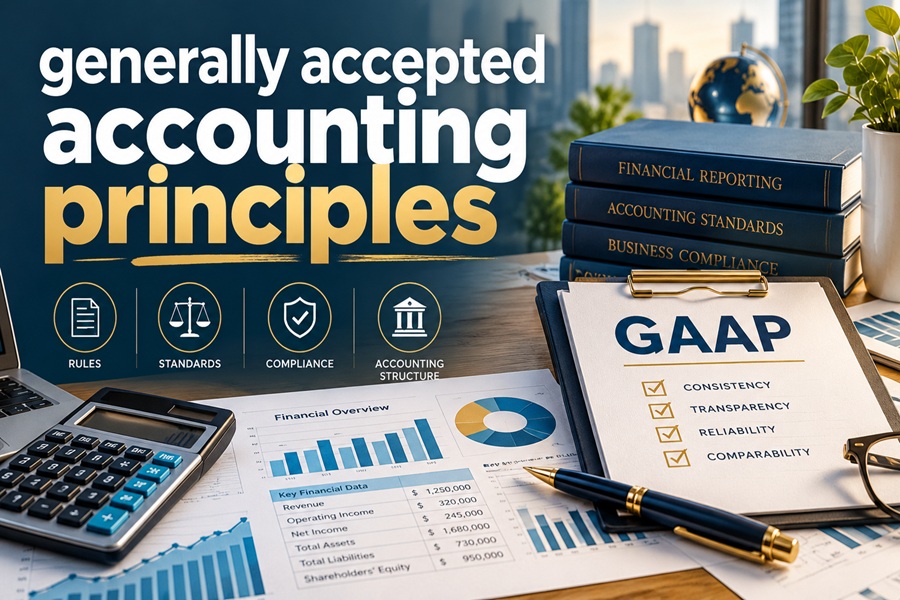
GAAP is the common set of standards, rules and procedures that companies in the United States follow when they prepare financial statements. It tells them what to count, when to count it, how to measure it and what to disclose. The goal is not perfection. It is consistency and transparency, so that a balance sheet from one company means roughly the same thing as a balance sheet from another.
GAAP is not a single book written in one go. It is a body of guidance that grows and changes over time, and it is organized into a structure called the Accounting Standards Codification, which groups rules by topic such as revenue, leases, inventory, income taxes and credit losses.
Who writes the rules
- The FASB (Financial Accounting Standards Board) is an independent, private organization that sets GAAP for businesses and not for profit organizations in the United States. It issues changes as Accounting Standards Updates, often called ASUs.
- The GASB sets standards for state and local governments.
- The SEC has legal authority over the financial reporting of public companies, and it recognizes the FASB’s standards as authoritative for them.
Who has to follow it
Public companies in the United States must file GAAP financial statements. Private companies are not always legally required to, but in practice most follow GAAP because banks, investors, acquirers and auditors expect it. Tax returns are a separate matter, since tax rules differ from GAAP in several places, so the profit on a tax return and the profit in the financial statements are often different numbers.
The ideas underneath the rules
GAAP is full of detailed guidance, but it grows from a handful of core ideas. Learn these and the rest makes sense.
| Principle | Plain English meaning | Quick example |
|---|---|---|
| Economic entity | Keep business and personal finances separate | An owner’s holiday is not a company expense |
| Going concern | Assume the business will keep operating unless there is evidence otherwise | Equipment is spread over its useful life, not valued as if sold tomorrow |
| Monetary unit | Record things in a stable currency | Report in dollars, not in hours or units |
| Time period | Divide life into reporting periods | Monthly, quarterly and yearly statements |
| Historical cost | Record assets at what you paid, then adjust for use | A building bought long ago stays at cost less depreciation |
| Revenue recognition | Record revenue when it is earned | A sale counts when the customer receives the product or service |
| Matching | Pair costs with the revenue they help create | The cost of goods sold lands in the same period as the sale |
| Full disclosure | Give readers what they need to understand the numbers | Lawsuits, debt terms and policy choices go in the notes |
| Consistency | Use the same methods from period to period | Do not switch inventory methods to flatter profit |
| Materiality | Focus on what would change a reader’s decision | A missing pen is ignored, a missing million is not |
Revenue recognition, the rule everyone fights about
Revenue is the number most open to creativity, so the standard that governs it is detailed. It follows five steps.
- Identify the contract with the customer.
- Identify the separate promises, or performance obligations, in that contract.
- Determine the transaction price.
- Allocate that price across the promises.
- Recognize revenue when each promise is fulfilled.
A software company that sells a subscription with setup help, for example, cannot book the full price on the day of signing. It must spread recognition across the service period and the setup work according to what has actually been delivered.
What GAAP shapes on the page
GAAP governs the full set of financial statements:
- The balance sheet, a snapshot of assets, liabilities and equity
- The income statement, showing revenue, expenses and profit over a period
- The cash flow statement, showing where cash came from and where it went
- The statement of changes in equity
- The notes, which carry explanations, policies and detail that the main statements cannot
GAAP versus IFRS
Outside the United States, most countries use International Financial Reporting Standards, known as IFRS, which are followed by well over a hundred jurisdictions. The two systems share most of their foundations but differ in places that matter.
| Topic | US GAAP | IFRS |
|---|---|---|
| Style | More detailed, rules heavy | More principles based, relies on judgment |
| LIFO inventory method | Allowed | Not allowed |
| Reversing inventory write downs | Not allowed | Allowed if value recovers |
| Development costs | Generally expensed | Capitalized when specific criteria are met |
| Property revaluation | Cost model only | Revaluation model permitted |
| Lessee lease accounting | Operating and finance lease distinction retained | One main model for most leases |
What is changing in 2026
GAAP never stands still, and this year is a busy one.
Several updates take effect for calendar year 2026 reporting, covering income tax disclosures, credit loss measurement, induced debt conversions and stock based compensation. Public and private entities often have different effective dates, so a company’s size and status decide which changes it must apply this year.
Two newer updates are on the horizon. One issued in April 2026 deals with paid in kind dividends. Another issued in May 2026 creates a brand new topic on environmental credits and the obligations that can be settled with them, an area that had no explicit guidance before. For public companies it applies to annual periods beginning after 15 December 2027, and for private entities a year later. The FASB also advanced several projects expected to produce exposure drafts later in 2026, and it has been trimming references to its non authoritative concepts statements from the codification.
Common misunderstandings
- “GAAP guarantees accuracy.” It does not. It guarantees a consistent framework, and estimates inside it, such as bad debts or asset lives, still involve judgment.
What it means for a small business owner
You do not need to memorize the codification. You need good habits. Keep accrual based books, record revenue when it is earned, track costs against the right periods and keep supporting documents. Ask your accountant whether lenders or investors will want compiled, reviewed or audited statements, since the level of assurance changes how closely your books must follow GAAP. And if a contract looks unusual, ask about the revenue treatment before you sign, not after the year closes.
The takeaway
GAAP is the shared language that makes financial statements comparable and trustworthy. Its principles are few, its detailed rules are many, and it keeps evolving as business does. Learn the ten ideas, understand where judgment enters, and you will read any set of accounts with sharper eyes.






Comments